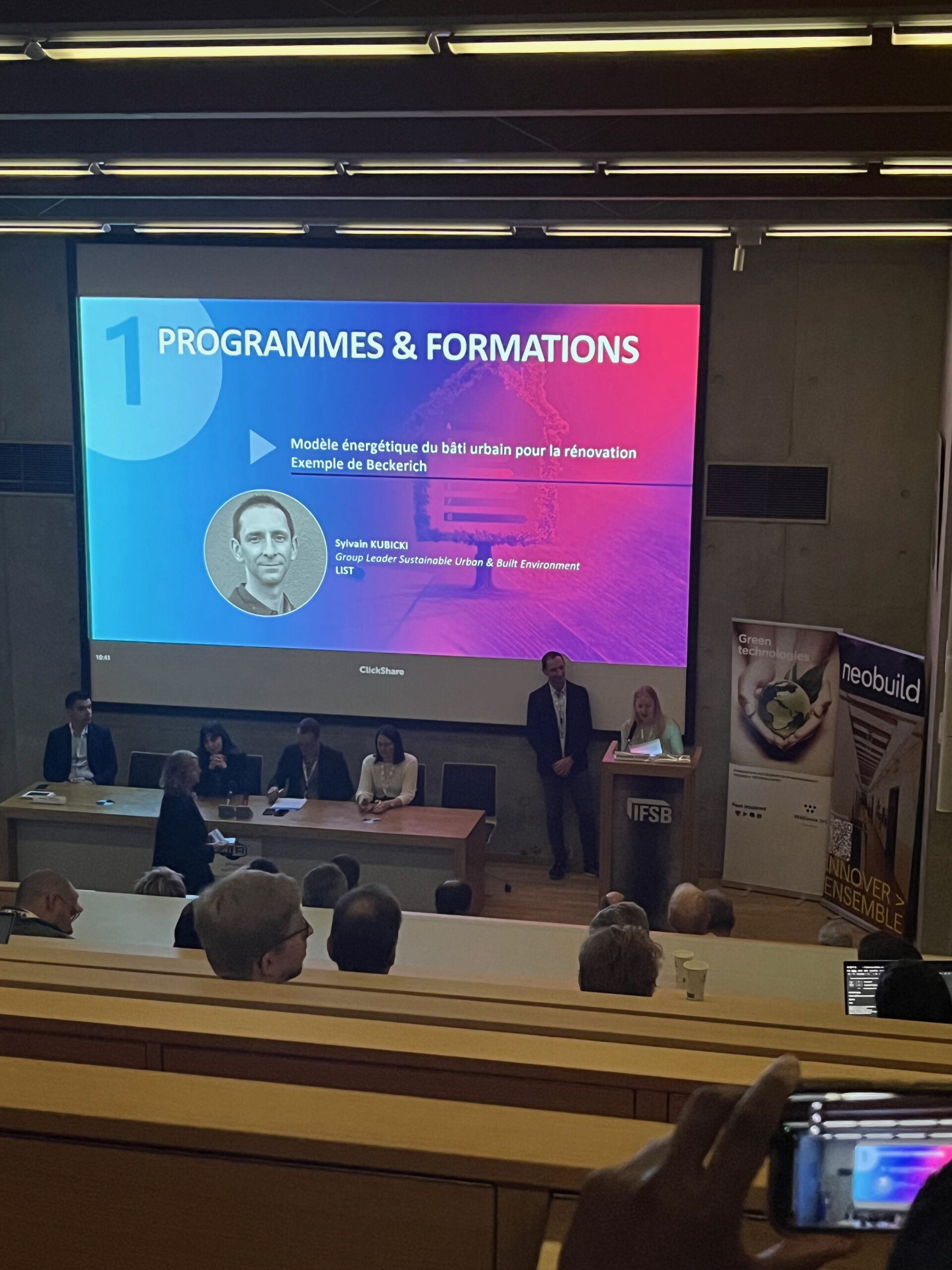
On 21 May 2026, LIST and Beckerich colleagues attended the AWEX-Neobuild Conference “L’Énergie dans la Construction en Grande-Région”.
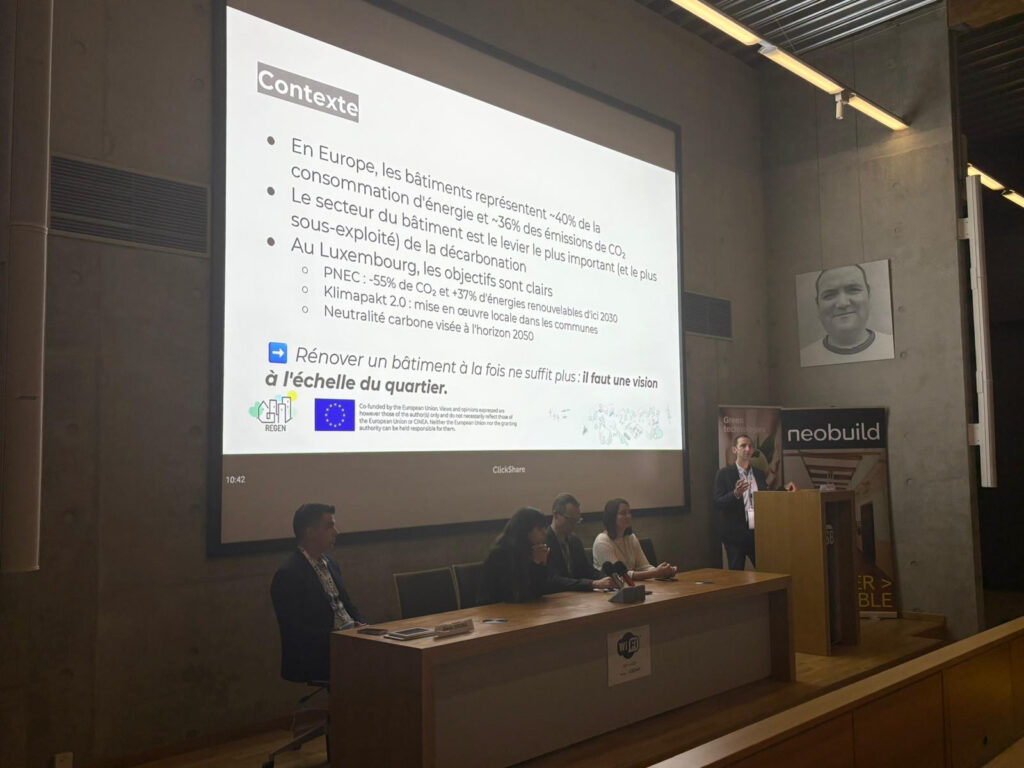
REGEN project coordinator Sylvain Kubicki (LIST) presented the project’s latest results. The conference was held in Bettembourg, Luxembourg before an audience of approximately 100 professionals from Belgium, Luxembourg, France and Germany. The event was opened by H.E. Charles Delogne, Belgian Ambassador to Luxembourg, underlining the cross-border political significance of energy transition in the built environment.
Modelling the entire building stock of a municipality
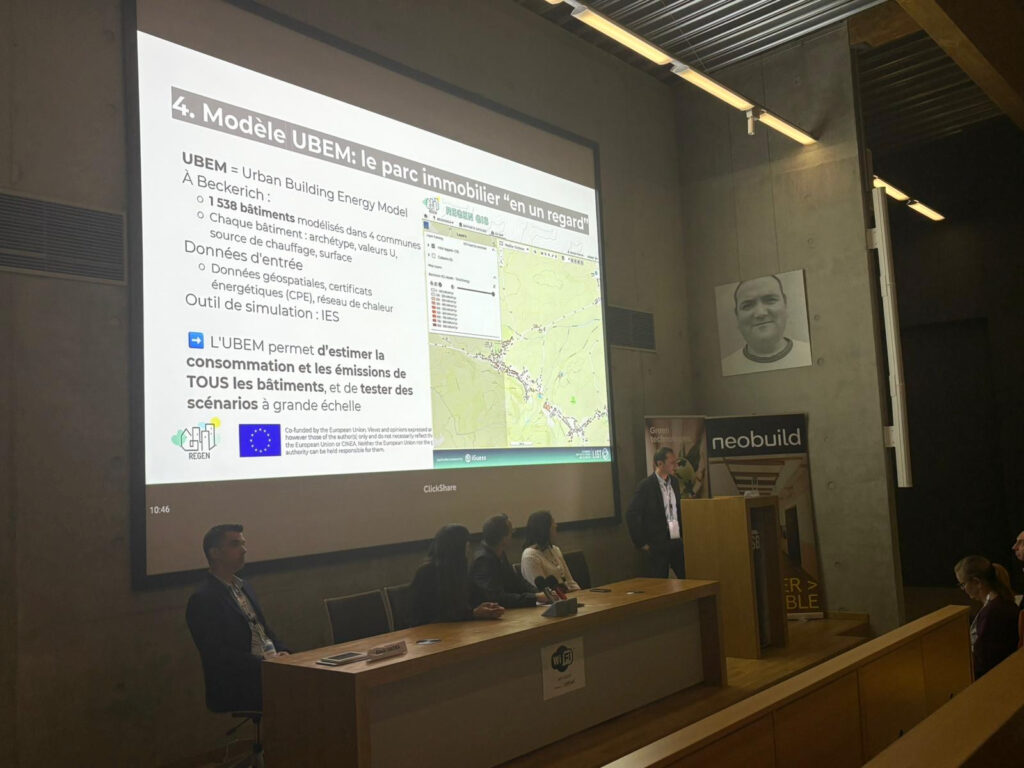
Sylvain presented the Urban Building Energy Model (UBEM) developed by LIST for the Beckerich demo site, covering 1,538 buildings across 4 municipalities. Built using geospatial data, energy performance certificates and district heating network information, and the computational simulation of our partner IES R&D, the model enables simulation of energy consumption and CO₂ emissions at full municipal scale, as well as the systematic testing of renovation scenarios across the entire building stock.
The scenarios combine two levers: envelope renovation (from light insulation to full deep renovation with window replacement) and heating system upgrades (district heating, heat pumps, PV). Two renovation rate pathways are modelled: a business-as-usual trajectory of ~1% per year, and a climate-aligned pathway at ~3.5% per year, in line with Luxembourg’s PNEC and Klimapakt 2.0 objectives.
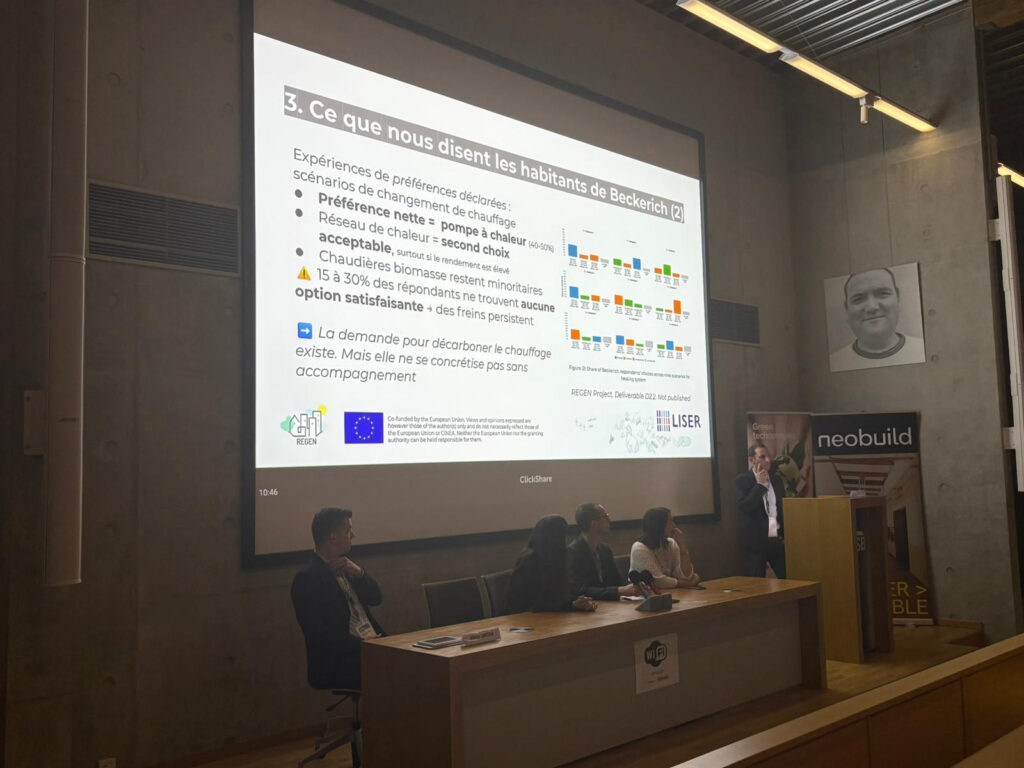
What residents tell us
A survey of 78 households in Beckerich, led by our partner LISER, revealed that the willingness to decarbonise is real, but barriers are financial and structural, not a lack of awareness. Heat pumps would be the preferred heating option (40–50%), yet 15–30% of respondents find no satisfying alternative. Decarbonisation of heating requires active support, not just technology.
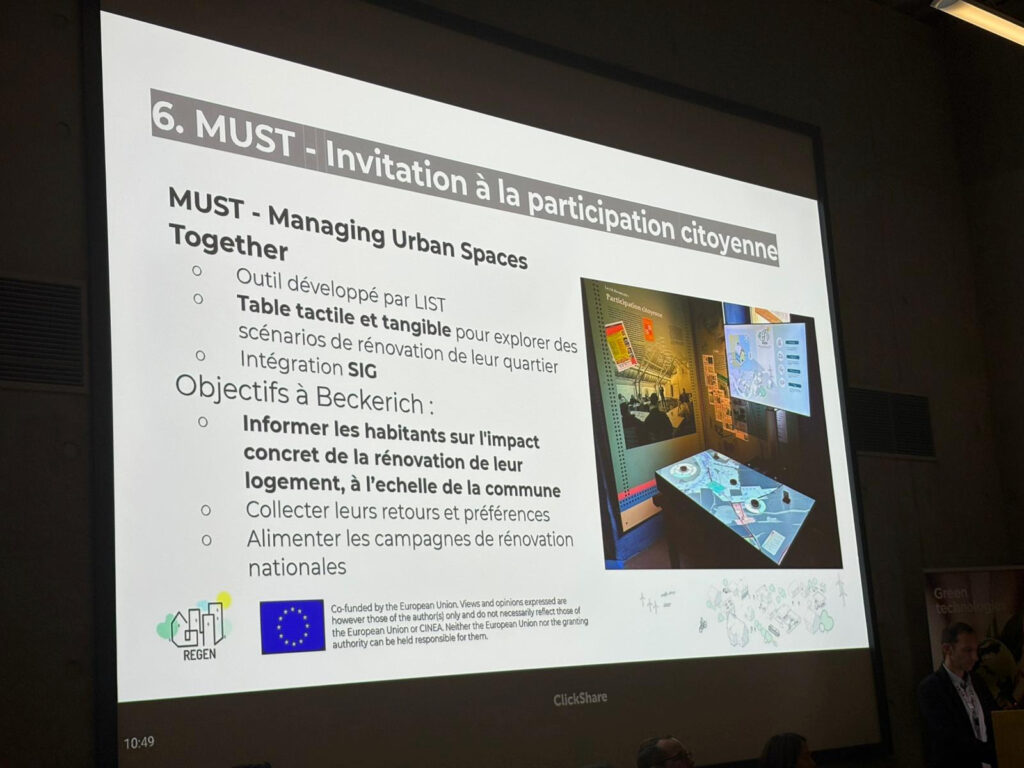
Citizen participation with MUST
The presentation also introduced MUST — Managing Urban Spaces Together, LIST’s tangible interactive tabletop tool designed to help residents explore renovation scenarios for their neighbourhood, share preferences, and contribute to national renovation campaigns REGEN. The first citizen workshop in Beckerich was launched the very next day.
A well-aligned contribution to the Greater Region’s renovation ecosystem
REGEN’s data-driven, citizen-centred approach resonated strongly with the conference’s broader programme, which brought together actors across six thematic blocs: programmes & training, energy & renovation, design & studies, data flows, geothermal energy, and district heating networks. This event was a rich illustration of the cross-border renovation ecosystem taking shape in the Greater Region.
No responses yet