Urban Demonstration Site:

Dublin . Ireland
2.3 sq.km
Extension of the demonstration area
2408
Number of buildings
86
Non-residential buildings
5820
Population
The Dublin demo site will concentrate on the Irishtown & Ringsend area designated as a ‘Decarbonising Zone’ (DZ). A DZ is a spatial area identified by the local authority, in which a range of climate mitigation action owners are identified to address local low carbon energy, greenhouse gas emission and climate needs to contribute to national climate action targets. The zone must consider the main projects that could be deliverable in terms of GHG reductions. At a minimum, these outcomes must be capable of meeting the Irish Government’s targets for carbon emissions reduction, a 51% reduction by 2030.
This zone is also located in a ‘Strategic Development and Regeneration Area’, which has obligatory objectives around regeneration, specifically on sustainable energy and climate change, as set out in the Dublin City Development plan. Dublin city is also on of the cities in EU Mission’s Net-Zero Cities initiative.
Main partners
REGENERATION ACTIONS
These actions currently reflect each neighbourhood’s goals, but remain indicative and may be adjusted if unexpected constraints arise.
Deploy NRO – Raytown Energy Dock to co- create carbon neutral future of Ringsend and Irishtown with citizens and other stakeholders
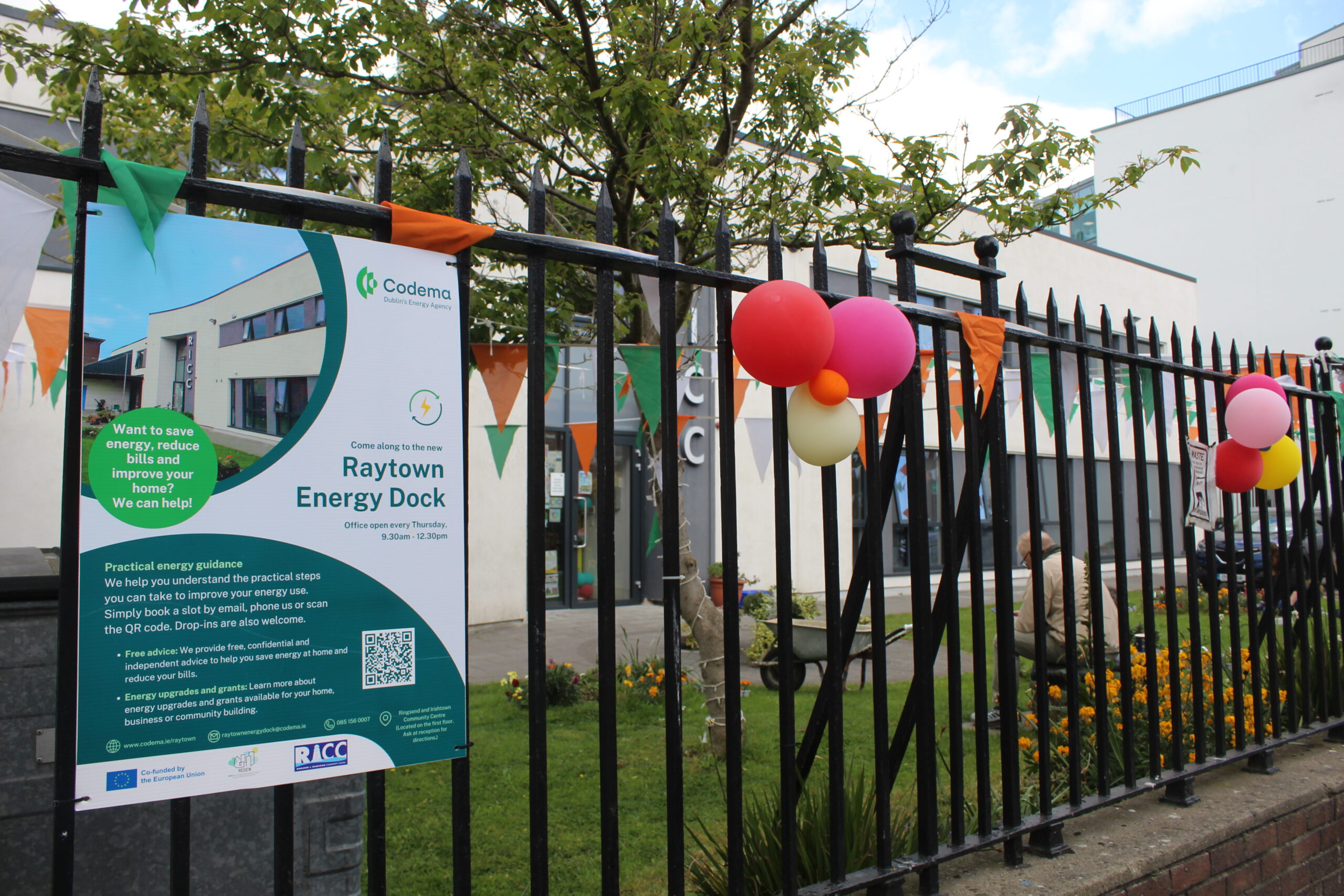
The Neighbourhood Regeneration Offices are the heart of the REGEN project and Codema has taken the lead of this action by establishing the new office in RICC – Ringsend and Irishtown Community Centre, a well- known organization established in 1989 to support the local community.
The establishment of the NRO in one of the existing community centres already operating in the area will ensure greater citizen participation, as it is a place they are familiar with and where various events are already held such as Afterschool support, Community Services Programme, Youth.
INTERVENTIONS REPLIED BY THIS ACTION:
• N10: Educate citizens on their energy use to facilitate energy savings in buildings (utilise smart metering, promote the use of monitoring apps and/or automated systems)
• N49: Neighbourhood Regeneration Office
EXPLANATION OF THE ACTION:
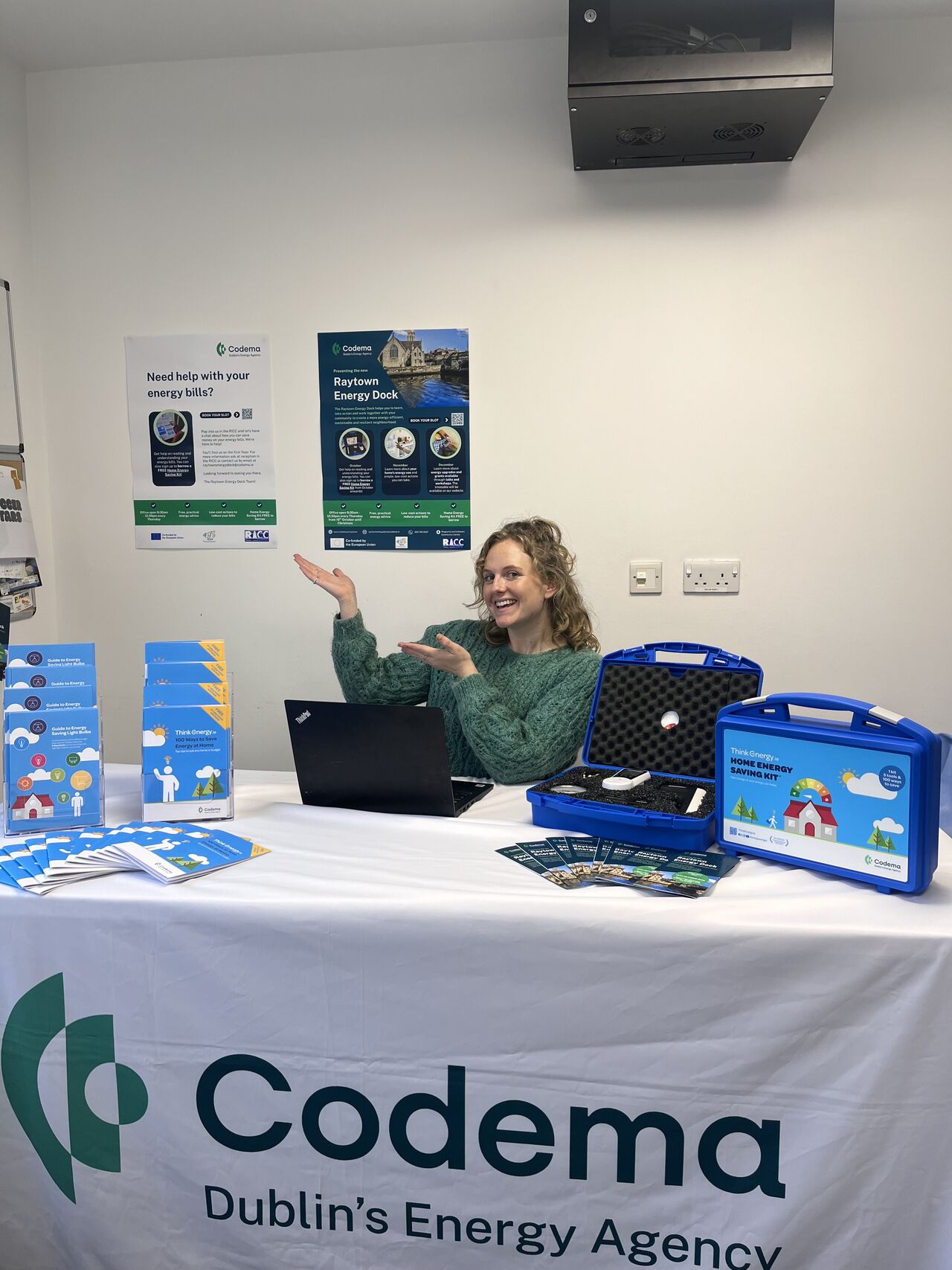
As part of the REGEN project, Codema opened the Raytown Energy Dock (NRO) in October 2025. The office is located in a reputable community centre in the heart of Ringsend called the Ringsend/Irishtown Community Centre.
The aim of the office is to provide energy advice and support to the local community using digital tools and participatory engagement methods. The office is open every Thursday from 9:30am to 12:30pm. Codema has and will continue to organise relevant workshops and events to raise awareness of the REGEN project and provide necessary support to the local community.
Dublin Pilot Energy Scenario Modelling to 2030
This task involves developing an energy model of the Dublin REGEN area using IES tools suite. The work will generate a calibrated baseline, a Business-as-Usual (2030) scenario, and multiple decarbonisation scenarios.
INTERVENTIONS REPLIED BY THIS ACTION:
• N11. Performing Energy Analysis and modelling (using IES tool) to improve energy savings (Codema)
EXPLANATION OF THE ACTION:
The scenario specifications process began with a structured review of DCC CAP 2024–2029 actions relevant to:
• Public-sector building retrofits
• Energy efficiency upgrades
• Heat decarbonisation
• On-site renewables (solar PV)
• Associated enabling measures
We then target actions that:
1. explicitly aimed at 2030,
2. could be quantitatively represented in IES energy model,
3. Prioritise measures that have clear physical/technical effects on:
a. Building fabric (U-values, airtightness, thermal mass)
b. Heating systems
c. Electricity consumption / loads
d. On-site renewable generation
This ensures the model is robust, technically sound, and avoids unrealistic assumptions.
IES is to generate the energy model using the scenario specification guidelines that was co-defined between them and Dublin’s local partners.
Measures the smart readiness of newly equipped buildings
This task involves establishing the smart readiness of residential buildings in the Dublin demo site through the use of, and response to, smart metering data.
INTERVENTIONS REPLIED BY THIS ACTION:
• N3. Measuring smart readiness in buildings from Energy Community
• N9. Deploy active solutions to reduce buildings energy needs.
• N14. Setting up energy communities (legal entity) to manage the renewable energy consumption
EXPLANATION OF THE ACTION:
The work began with a review of housing stock within the demo-site area to identify the most common housing types and associated home energy systems (heat, light, on-site generation, EV charging etc.,). This review provided the basis data for selecting pilots for inclusion in the study. Following recruitment, baseline energy usage data is collected for two pilot homes using smart metering. This includes measurements of energy consumption, dynamic and base load use along with cost data over a 12- month period. The two homes are then subject to a smart readiness indicator (SRI) assessment.
The results of the SRI are used to identify recommendations for improving the SRI score and performance. Once improvements are verified, 8 additional pilots are recruited to the project to provide additional results for different housing stock scenarios and to demonstrate the application of standard solutions that can be replicated widely in the community.
The smart metering dashboard is used to raise awareness and educate the practitioners on energy use and efficiency. The smart metering dashboard that reports on half hourly consumption and trends as well as a comparison of their costs on a standard tariff and a dynamic (half hourly) tariff.
The dashboard functionality also allows for the pilots to evaluate the response to explicit demand response signal. Engagement and improved awareness will result in energy efficiency.
Engagement of citizens through digital tools
This action focuses on empowering citizens with accessible, spatially relevant, and data-driven energy insights, enabling them to understand, manage, and reduce their energy use, have a better knowledge of the local energy initiatives and potential RE solutions and be more involved in the initiatives at neighbourhood level.
The ultimate goal is to leverage the REGEN data and digital initiatives into participative work with the citizens. By combining digital engagement tools, interactive visualisation, and participatory workshops, the action aims to shift citizens from passive energy users to active participants in the local energy transition.
INTERVENTIONS REPLIED BY THIS ACTION:
• N10: Educate citizens on their energy use to facilitate energy savings in buildings (utilise smart metering, promote the use of monitoring apps and/or automated systems)
• N11: Performing Energy Analysis and modelling (using IES tool) to improve energy savings
• N49: Neighbourhood Regeneration Office
EXPLANATION OF THE ACTION:
As part of the REGEN activities, Codema is planning to involve citizens and key stakeholder groups in participatory processes organised in the Raytown Energy Dock (NRO) for which innovative decision-making procedures and digital tools will be used.
The local level datasets (including information already available in Dublin’s IES model), will be used in the participatory processes through the MUST software/interactive tangible table and digital i-pads (to be approved by coordinator) to help them to understand the local energy use, local energy initiatives (e.g. RISEC buildings and RE systems) and potential renewable energy solutions in the local area.
Codema is expecting to carry out at least 3 workshops with different stakeholders’ groups
Setting up the Ringsend-Irishtown Sustainable Energy Community
This action focuses on the development of an Urban Energy Cooperative to support a community driven energy transition and enable the upscaling of local renewable energy ownership.
INTERVENTIONS REPLIED BY THIS ACTION:
• N14: Setting up energy communities (legal entity) to manage the renewable energy consumption
• N10: Educate citizens on their energy use to facilitate energy savings in buildings (utilise smart metering, promote the use of monitoring apps and/or automated systems)
EXPLANATION OF THE ACTION:
The Ringsend Irishtown Sustainable Energy Co-operative (RISEC) is being established to provide community control over how energy is produced, owned, and used in the areas. RISEC registered as a legal entity (Company Limited by Guarantee) in 2025 and has a strong and active Board of Directors.
A programme for community engagement, including community-based participatory workshops, is determining opportunities for reducing energy use and collective ownership of, and/or benefit from renewable energy projects.
Develop district heating guidance
This is an opportunity to make progress on work to prepare the ground for any potential future connections of the Dublin District Heating Project (DDHP), which is a Project being delivered. The DDHP will initially capture heat produced at the Dublin Waste to Energy (DWtE) facility located in the Poolbeg Peninsula and reuse it for all spatial and water heating requirements to homes, businesses and civic buildings in the Poolbeg, Ringsend and Docklands areas of Dublin city via a district heating network. The medium for circulating heat within the district heating network and transferring heat to customers is water. The DDHP will eliminate the need for individual private heating solutions for buildings.
INTERVENTIONS REPLIED BY THIS ACTION:
• N12: Deploy district heating network to have more sustainable energy sources
EXPLANATION OF THE ACTION:
Strategy for connecting the DDHP: The REGEN project provides a strategic opportunity to advance preparations for potential future connections between the Dublin Docklands District Heating Project (DDHP) and local stakeholder buildings— the first of its kind at this scale in Ireland. As part of this work, Codema and DCC have initiated the delivery of analysis and guidance on preparatory measures that both stakeholders and the operator of the DDHP can undertake, informed by building archetype modelling. This will help ensure that local buildings are well positioned to integrate with the network if and when the opportunity arises.
Roll out of sensors to measure traffic congestion
Codema is exploring the possibility of aligning ongoing traffic sensors installation with the Dublin demo activities and datasets. Neither Codema nor DCC are ultimately responsible for installing those meters; however, Codema has identified this as a positive action for the ongoing activities at the pilot site and is currently exploring its alignment.
INTERVENTIONS REPLIED BY THIS ACTION:
• N28. Manage mobility behaviour (pedestrian, motorized, transportation…) to address the carrying capacity and human traffic – Monitor and analyse patterns and real-time usage of public spaces.
EXPLANATION OF THE ACTION:
There are a number of external initiatives happening in the area that have been identified in the previous years following the local diagnostic. Some of them are tackling the roll out of sensors that support data collection on key urban challenges.
More specifically Smart Docklands, a smart city testbed in the heart of Dublin’s Docklands established in 2018 and funded by Dublin City Council (DCC) and CONNECT, together with UCD is deploying a network of citizen science traffic counters across the Dublin Docklands, including the Dublin pilot area. This will provide citizens with access to data about different modes of transport used in their local area.
As mentioned, Codema is currently in discussions with the relevant stakeholders – Smart Docklands and UCD – to redirect part of their efforts toward the REGEN area and support the scaling up of their rollout by deploying these devices in the Dublin pilot area. The data collected by the sensors will directly feed into the REGEN datasets, including AFUR.
Latest news from Dublin
Horizon Europe
Co-founded by the European Union. Views and opinions expressed are however those of the author(s) only and do not necessarily reflect those of the European Union or CINEA. Neither the European Union nor the granting authority can be held responsible for them.
Contact
Sylvain Kubicki
REGEN Coordinator, Luxembourg Institute of Science and Technology (LIST)
sylvain.kubicki@list.lu
Coralie Vella
DEC Manager of REGEN project, R2M Solution
coralie.vella@r2msolution.com